Suffolk · Riverhead
Riverhead still has private wells. Calverton is next door.
If the kitchen is off the mains, mail a lab kit. Do not copy Calverton site numbers onto every Riverhead street.
Updated 2026-09-11 · Pipedeck · Riverhead, NY
| Riverhead well | Calverton site | |
|---|---|---|
| What it is | A private well on a lot at the fork | Navy/Grumman file next door |
| First step | Mail-in kit if no water bill | Stay on the Calverton page |
| Numbers you use | This tap's report | Site figures only |
| County $100 test | Different panel | Not a site census |
| This hop | Well kit | Not this URL |
East End, not a water district cartoon
Riverhead sits at the fork. The island peels into two forks here. Lots still run a well and a septic on the same sand. Suffolk's water plan still talks about tens of thousands of private wells countywide. Riverhead is in that world more than a Hempstead water-district block.
Suffolk's plan cites about 45,000 private wells, on the order of 200,000 people. That is a plan figure, not a census of this town. This page will not invent a Riverhead well total the public record used here did not publish. Nassau has about 500 private wells in the whole county. The East End lives on the Suffolk side of that split. More wells than Nassau is the county fact. It is not a claim that every Riverhead kitchen skipped a main.
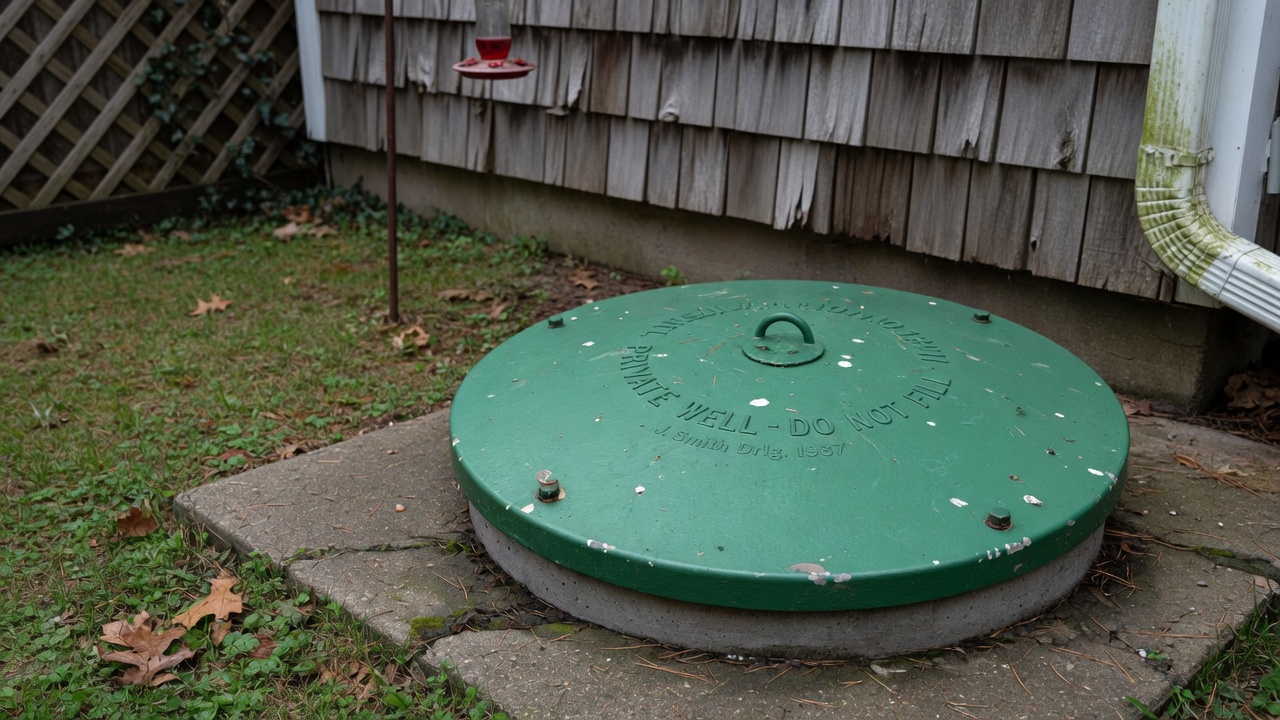
Some streets already pay a water-district bill. Some still drink a private well. Mixed lots exist at the fork the same way they exist in other Suffolk towns. The town name on the envelope does not settle the pipe. Walk the grass for a round cap. Listen for a pump and a pressure tank. Then look at the mail. If a water-district bill never shows up, treat the kitchen as a well until a lab says otherwise.
A Hempstead kitchen is usually on a main. A typical Nassau block is public supply. Riverhead is East End geography. Do not paste a Nassau plant number onto a kettle at the fork. Do not paste Hempstead's public-well file — 1,4-dioxane in 7 of 9 wells in the record used here — onto a private cap in this town. Hempstead is a public-supply story. This URL is a well if the house still drinks one.
The county-wide kit steps live on the Suffolk wells page. Fill bottles there. This page is the Riverhead fork: already on the main, or still a well, with Calverton next door as a named site and not as a town-wide score.
Calverton is next door. Main Road is not that file.
Calverton's old Navy/Grumman site is in the Town of Riverhead. Those dioxane and PFAS figures are site figures. They are why a well kit matters if you are on a well near there. They are not a blood test for Main Road. They are not a census of every faucet that shares a town name with the pin.
Do not copy 14.9 ppb onto Main Road. That number is a named-site 1,4-dioxane reading against New York's 1 ppb drinking-water line. It belongs on the Calverton page with the rest of that file. PFNA at the plant is another named compound in the same family, on a parts-per-trillion ruler, not a parts-per-billion ruler. Keep the units. Do not average two chemicals into a percent of the town. Do not hang a plant sample on a kitchen that was never tested.
Plume language in the public record used here points toward the Peconic. Motion on the order of a foot a day is slow on a wall calendar and still motion in sand. A remediation study has been talked about toward 2039. Public remarks about samples at that site have put some PFAS readings on the order of a hundred times the state drinking-water line. All of that is still a site sentence. It is not a street list for the fork. It is not a result for the glass you poured this morning. You do not have to track the cleanup to decide whether this house drinks a well. You do have to measure this kitchen if it does.
This is not the Bethpage plant. Bethpage is Nassau, mostly public water, and a different solvent story — a TCE plume on the order of four miles by two. Do not copy a Bethpage water bill onto a Riverhead well because both names say Grumman. Do not copy Medford and Bellport mains-extended-later onto this town as if that were a construction calendar for the fork. Those pages exist because those streets are not interchangeable.
Mattituck sits past the fork in Southold Town. In one round there, 20 of 38 private wells sat over the PFAS limit, some about sixty times over. Eighteen of those wells were not over the line. None of that math is a Riverhead census. Keep 20 of 38 on the Mattituck page. An untested well at the fork is untested.
The bill and the cap, not a town well census
Start outside. A round cap in the grass, often close to the house, usually means a well. A pump and a pressure tank in a basement or a small well house point the same way. Then look at last month's mail. A regular water-district bill usually means the kitchen is on a treated main. No water-district bill, plus a cap, usually means a private well. The house next door can pay a district while yours still draws from the yard. A neighbor's tap is not your pipe.
If you just got the keys, ask for the last water bill and walk the grass that week. Closing papers can name a well and still skip the two chemicals this kit is for. If you rent, ask who pays the water and whether there is a cap. Silence is still a well until a lab. If the well only waters the lawn and the kitchen already sits on a treated district line, skip the kit. If people still drink, cook, and make coffee from the well, this kit is the job.
A house that sits dark on weekdays is still the same sand if anyone drinks when it is open. A dark weekday does not put a plant on the pipe. Bottled water on the counter does not name the kettle. If the pasta pot, the ice, or the glasses on the table still come from the well, you are still drinking the well.
Clear water is not a test. Taste is not a test. A neighbor who never had a problem is not a test. Forever chemicals do not announce themselves in the glass. New York limits two common PFAS — PFOA and PFOS — at 10 parts per trillion in drinking water. You will not taste that. You will not smell it. A twelve-dollar hardware-store strip is built for chlorine, hardness, and a few metals you match to a color chart. It will not find PFAS. It will not find 1,4-dioxane. A water softener treats hardness. It does not close this gap either.
From 2016 through 2022, Suffolk sampled private wells. About 47 percent of those wells showed some PFAS. Two hundred two of them were over drinking-water standards. That is the wells they sampled. It is not a score for every house in the 45,000-well plan figure, and it is not a Riverhead-only census we are going to invent. "Some PFAS" is not "over the limit." Do not multiply those shares by the plan figure and call the product a town count. Suffolk was in the state's well PFAS pilot. That is why the question comes up here more than it does two counties west. The only bottles that name this tap are the bottles you fill here.
Two tests. The kit steps live on the well guide.
Two products get searched as one Riverhead well test. They are not the same product.
Suffolk still sells a $100 private-well test. Call 631-852-5810 if you want that product. It is a real lab. It is cheap. It looks at bacteria, nitrates, and the metals people have asked the county about for years. It does not look for PFAS. It does not look for 1,4-dioxane. This site is not that office. Keep their test if you want their check. Use a mail-in kit if you want the chemicals New York now limits at the tap.
The mail-in lab kit is the panel that can name PFAS and 1,4-dioxane at drinking-water levels. That is why the button on this page is a well kit, not a pitcher and not a county appointment. A click here does not book a county slot. The county number does not sell the button on this page. Keep the phone with the county. Keep the bottles with the lab.
How to fill the bottles is the well guide. Order the kit. Use the cold kitchen tap you actually drink from. Then follow that page. Do not treat this town URL as a second copy of the sampling card. One kit covers the house. Two glasses on one tap do not need two boxes. If a recent lab report already sits in the drawer and already names PFAS or 1,4-dioxane, you may not need a second kit to postpone a filter you already know you need. If the paper is old, or it never looked for those chemicals, start with the kit.
Long Island drinks from one sand aquifer, designated sole-source in 1978. Nassau and Suffolk have no backup drinking water. A private well in Riverhead is that sand at this house. Public water is that sand after a district treats it. Either way the tap is local. The well just means the treatment step is yours — after you measure. The sand story lives on the aquifer page. This page stays on this address.
After the report, match the chemical
If a water-district bill already arrives, skip this kit. Start with the tap guides for PFAS and 1,4-dioxane. Public water is treated. You may still want a filter that matches those chemicals. Look for NSF 53 or P473 on the box, or reverse osmosis under the sink. A fridge pitcher that only says it filters water is usually chlorine and taste. 1,4-dioxane needs reverse osmosis. A pitcher is a refund for that chemical. Do not paste a neighbor site's plant file onto a Riverhead district tap either.
If the well report comes back high for PFAS, get a filter made for that chemical. Shop a unit that was tested for those compounds. Reverse osmosis also covers them. Test first if you drink a well. Buying the box first is how a pitcher ends up in the fridge and the well stays the well. If 1,4-dioxane is high, skip the jug. Reverse osmosis is the class. New York's comparison line for 1,4-dioxane is 1 part per billion. The 14.9 figure is the site next door, not a substitute for your bottles.
Cartridges are a yearly cost after you install something that actually matches the report. That later bill lives on the replacements page, not here. Write the change date on the housing if you already have a unit. A neglected membrane is a slow tap with the old chemistry still in it.
Do not hang a Calverton site number on a kitchen that was never tested. Do not hang a county sampled share on a lot that was not in that set. Do not hang a Superfund headline on either job. The island has 34 federal plus 449 state listed sites — 483 in all, not 500 Superfunds, not 500 NPL. Those listings sit on the same sand. They do not tell you whether this Riverhead kitchen is a well. The bill does. The cap does. Then the kit, or the filter class.
Same sand, different Saturday
Most of Suffolk is still unsewered. About 26 percent of Suffolk homes are on a sewer. About 74 percent are not. The county still talks about 360,000 on-site systems — septic tanks and cesspools — on the same sand that later shows up in the glass. Nassau is about 85 percent sewered. Riverhead did not flip that county split. Unsewered is not the same as a private well. Plenty of lots pay a water-district bill and still send bathroom water into a tank. Plenty of lots run a well and a tank on the same sand. Those are two setups.
Nitrate in the Magothy aquifer rose more than 80 percent from 1987 to 2013. That is leftover plumbing on sand, not a PFAS meter. A nitrate strip can be a later job. It is not a substitute for the kit this page is about if the kitchen still drinks a well.
Ticks in the same grass are a clothes job on the ticks page. East End ticks live in grass and at the field edge. That is ecology, not Superfund, and not this kit. Do not hang a well report on a pant cuff. Do not hang a filter on the hedge. The how-to for treated clothes stays on that URL. This URL stays the kitchen.
This site is not a lab, not the county, and not a help desk. Legal mail only: 65 Cedar Street, Kings Park, NY 11754. There is no personal phone on this page. The county well number is 631-852-5810 — that is them, not us. Bottles go back to the lab that shipped them. Not to Kings Park.
If you buy through a link on this page, we may earn a commission. How that works
Common questions
Is Riverhead on public water?
Some streets are. Some are not. A missing water bill is the tell. Treat a well as a well. The town name on the envelope does not settle the pipe.
Do I use Calverton's 14.9 ppb on my tap?
No. That is a named site. Do not copy 14.9 ppb onto Main Road. Test your kitchen.
Is this the Calverton page?
No. Calverton keeps the Navy/Grumman pin and the site figures. This URL is the Town of Riverhead at the fork. Next door is not a census of every tap.
Does Suffolk's $100 well test look for PFAS on a Riverhead well?
No. Call 631-852-5810 if you want that cheaper county check. It looks at different things. A mail-in lab kit is the one that looks for PFAS and 1,4-dioxane. This site is not that office.
Do I still order a well kit if I already pay a Riverhead water bill?
No. Skip the kit on a district bill. Match a PFAS filter or reverse osmosis to the tap. The well button on this page is only for a kitchen that still drinks a well.
What if a Riverhead well report comes back high?
Match the chemical to the tool. NSF 53 or P473, or reverse osmosis, for PFAS. Reverse osmosis for 1,4-dioxane. A fridge pitcher is not that filter. Test first, then buy.
Is Mattituck's 20 of 38 a Riverhead census?
No. That sample lives on the Mattituck page in Southold Town. Do not paste it onto the fork. An untested Riverhead well is untested.
Are East End ticks the same job as this kit?
No. Ticks sit in grass and at the field edge. That clothes hop lives on the ticks page. This URL is the kitchen if the house still drinks a well.
Suffolk County well-plan figure (~45,000) vs Nassau ~500 private wells; 2016–2022 Suffolk well sampling; Nassau ~85% sewered / Suffolk ~26% sewered; Magothy nitrate 1987–2013; county well-test line 631-852-5810; New York drinking-water standards; 1978 sole-source aquifer; 34 federal + 449 state listed sites (Deziel 2025). Calverton site figures stay on /calverton/. Mattituck 20 of 38 stays on /mattituck/.