Your well
If this Suffolk kitchen still drinks a well, mail bottles first
Order a mail-in lab kit, fill it at the cold tap you actually drink, and send the bottles. The button is a tagged Amazon storefront for that class. Suffolk's $100 county check is cheaper, and it looks at different things — not PFAS, not 1,4-dioxane.
Updated 2026-09-15 · Pipedeck
| County $100 test | Mail-in lab kit | Hardware strip | |
|---|---|---|---|
| Looks for PFAS | No | Yes — this class | No |
| Looks for 1,4-dioxane | No | Yes — this class | No |
| Who runs it | Suffolk County (631-852-5810) | A certified lab you send bottles to | A color chart at the sink |
| Best if | You want the cheap county check | The kitchen still drinks a well | You only care about hardness or chlorine |
| Skip if | You need the forever-chemical gap | The kitchen already sits on a district line | You think a dip stick is a PFAS test |
This page is the Suffolk kitchen that still drinks a well
Coffee. Pasta water. The kids' glasses after school. If those still come from a backyard cap, this Saturday is bottles from the cold kitchen handle. Order a mail-in lab kit from the tagged storefront on this page. Fill. Pack the same day. Send the bottles to a lab that names PFAS and 1,4-dioxane. If the well only waters the lawn and the kitchen already sits on a treated district line, skip the kit. The sprinkler is not the job.
It is also the week you got the keys. Closing papers can name a well and still skip the two chemicals this kit is for. A seller's last bacteria sheet is not this panel. If you rent, ask who pays the water and whether there is a round cap in the grass. Silence is still a well until a lab. If you left a Nassau tap for a Suffolk ranch, look for that cap the first week. Same-looking kitchen. Different pipe.
Nassau almost never needs this page. That county is about 85 percent sewered and has about five hundred private wells. Suffolk's water plan still cites about 45,000 private wells, and the same plan talks about 200,000 people on those wells. That is a plan figure, not a door-to-door count of your block. Use it as a size. About three-quarters of Suffolk homes are still on a septic tank or cesspool — on the order of 360,000 on-site systems. Suffolk is about 26 percent sewered. The well and the tank often sit on the same lot. Nobody is treating that drinking water on the way in. The sand under the island is a sole-source aquifer, designated in 1978. There is no backup river under the lawn.
Hamlet streets can mix both. One kitchen pays a district. The next still draws from the yard. A neighbor's water bill is not your pipe. Medford is the named mixed-street example. District lines arrived years after the houses. If your kitchen never got the district, treat it as a well. Town notes live on their own pages. This page is the Suffolk kitchen kit.
Cap in the grass, pump in the basement, no water bill
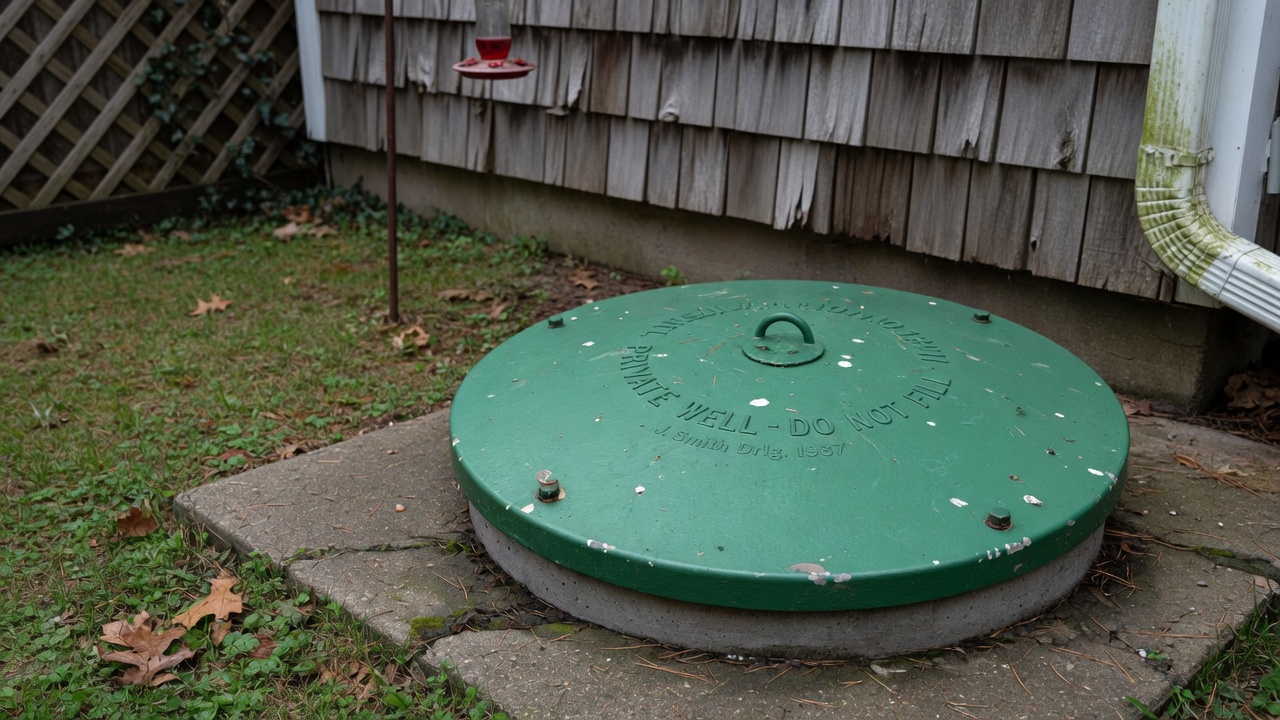
Walk the backyard. A low round cap in the grass is the usual sign. A pump and a pressure tank in the basement, or in a small well house, are the other tell. Some people grew up hearing that pump at night. That is the well, not a water-district line. If a water-district bill never shows up, treat the kitchen as a well until a lab says otherwise.
If you just got the keys, ask for the last water bill and walk the grass that week. A title search can name a well and still leave the two chemicals off the page. A home inspector's bacteria swab is a different job. Keep that paper if you have it. Send this kit anyway if people still drink from the tap.
North Fork streets sit on private wells more often than a typical Nassau block. In one round of testing, 20 of 38 Mattituck wells were over the PFAS limit — some about 60 times over. That is a reason to test that hamlet. It is not a score for your own kit two towns over. Bethpage is mostly public supply; a well kit there is only useful if you actually have a well. A Bethpage tap is not a stand-in for a Suffolk well.
Suffolk's $100 test and a hardware strip are other jobs
Suffolk still sells a $100 private-well test. Call 631-852-5810 if you want that product. It is a real lab. It is cheap. It looks at bacteria, nitrates, and the metals people have asked the county about for years. It does not look for PFAS. It does not look for 1,4-dioxane. This site is not that office. Keep their test if you want their check. Send a mail-in kit if you want the chemicals New York now limits at the tap. Running both is fine. Substituting the county panel for this kit is how a household thinks it tested forever chemicals and did not.
A $12 hardware-store strip is even narrower. It is built for chlorine, hardness, and a few metals you match to a color chart. It will not find PFAS. It will not find 1,4-dioxane. A cheap blister pack that says well water on the front is usually hardness and chlorine. Put it back. A nitrate strip can be a later job. Magothy nitrate rose more than 80 percent from 1987 to 2013. That is leftover plumbing on sand — septic tanks and cesspools — not a PFAS meter. It is not a substitute for the kit this page is about.
New York limits two common PFAS — PFOA and PFOS — at 10 parts per trillion in drinking water. 1,4-dioxane is a different chemical, with a 1 part-per-billion line. You will not taste either. You will not smell either. A clear glass does not mean the well is clear of them. Suffolk was in the state's well PFAS pilot, which is why this question shows up here more than it does two counties over.
One tagged storefront, mail-in class
You want bottles that go to a certified lab and a report that names PFAS and 1,4-dioxane. That is the class. The button on this page is a tagged Amazon storefront for a well lab kit this week. Fill at the cold tap you actually drink. Send the bottles. Wait. One kit covers the house. Two glasses on one tap do not need two boxes. Kids' glasses from the same tap are the reason to send bottles, not the outdoor hose.
Read the listing before you click buy. You still need a mail-to-lab panel that names PFAS and 1,4-dioxane. That aisle mixes those kits with hardware strips. If the carton is a dip stick, a 16-in-1 color chart, or a strip you hold under the faucet for ten seconds, it is not this page. Price is not a method. A well-cap thumbnail is not a lab. A tagged storefront is still a storefront: stay with the mail-in class.
A mail-in kit is a snapshot of one tap on one day. It is not a census of the 45,000-well plan figure. It does not treat the water. It does not hang a filter under the sink. You have to wait on the lab. You have to sample the cold tap you drink, without soap in the bottles and without a garden hose. If you fill from the hot side, or from an outdoor faucet you never use for coffee, the report is about the wrong pipe.
Do the PFAS and 1,4-dioxane kit once you know it is a well. Retest after well work, or when you want a new baseline. Bottled water is a stopgap while you wait on a system. It is not the house fix, and it is not a reason to skip the bottles.
Saturday at the cold handle
Order the kit. Open the box. Run the cold tap you actually drink from. Fill the bottles the way the slip says. Do not wash them with soap. Do not sample the hot side. Do not fill from a garden hose or an outdoor faucet you never use for coffee. Do not sample from a fridge door. Pack them the same day if you can. Send them. Wait. One kit covers the house.
If the slip says not to run the tap first, follow the slip. Some panels want first-draw. Some want a flush. The paper in the box is the method. Do not invent a third way because a forum said to let it run for ten minutes. Do not add ice. The kitchen cold handle is the well you drink.
After the report, not before
Do not buy a fridge pitcher first. A mystery jug that only says it filters water is usually chlorine and taste. Filters that speak to PFAS carry NSF 53 or P473, or they are reverse osmosis. For 1,4-dioxane, a pitcher is a refund. Reverse osmosis is the class. Test first, then buy. Buying the box first is how a pitcher ends up in the fridge and the well stays the well.
Do not buy a water softener for this gap. A softener treats hardness. It does not close PFAS. It does not close 1,4-dioxane. Do not buy a shower head, a travel flask, an ionizer, a sparkling-water maker, or cookware labeled PFAS-free. A pan coating is not the kitchen tap. A furnace cartridge is not drinking water. A whole-house rebuild before the report is a contractor Saturday you do not need yet. The glasses, the coffee, and the cooking water are the job after you know.
If the report later shows PFAS, shop a unit that was tested for those chemicals. The shopping page for that box is the PFAS filter guide. Cartridges are a yearly cost after you install something that actually matches the report. A one-time rebate does not buy next year. That later bill lives on the replacements page, not here. If the report shows 1,4-dioxane, a fridge pitcher does not remove it. The 1,4-dioxane reverse-osmosis guide is that next step. This page is still the test, because you should know what is in the well before you buy a system.
What the 2016–2022 sampling did and did not prove
From 2016 through 2022, Suffolk sampled private wells. About 47 percent of those wells showed some PFAS. Two hundred two of them were over drinking-water standards. That is the wells they sampled. It is not a score for every house in the 45,000-well plan figure. Your kitchen still needs its own bottles.
If you live near Calverton, the old Navy-Grumman plant left a groundwater problem nearby. Those site numbers live on that hamlet page. They are not a reading for this kitchen. If this house drinks a well, send bottles from this tap. Shop reverse osmosis only if the report calls for it.
Skip the kit if the kitchen already pays a district
If a water-district bill shows up, you are on public supply. Skip this kit. Start with the tap guides for PFAS and 1,4-dioxane. A Nassau yard with a cap is rare. A Suffolk ranch without a water bill is common. Mattituck still needs its own bottles. A Bethpage tap is not a stand-in for a Suffolk well.
This site is not a county office, not a lab, and not a help desk. The button sends you to a tagged Amazon storefront for a mail-in lab kit. The report is the first useful step. A hardware-store strip is not.
If you buy through a link on this page, we may earn a commission. As an Amazon Associate we earn from qualifying purchases. How that works
Common questions
Does Suffolk's $100 well test look for PFAS?
No. Call 631-852-5810 if you want that cheaper county check. It looks at bacteria, nitrates, and metals people have asked the county about for years. It does not look for PFAS. It does not look for 1,4-dioxane. The mail-in kit on this page is the one that names those two.
How many Suffolk homes are on a private well?
The county water plan cites about 45,000 private wells, and about 200,000 people on those wells. That is a plan figure, not a census of your block. Nassau has about five hundred. If this kitchen does not get a water-district bill, treat it as a well.
What should I pick on the Amazon storefront?
A mail-in lab kit: bottles from the cold kitchen tap, sent to a certified lab, with PFAS and 1,4-dioxane named on the listing. A dip stick, a 16-in-1 color chart, or a strip you hold under the faucet is not this page.
Can I fill the bottles from a garden hose?
No. Use the cold kitchen tap you drink from. A hose, an outdoor faucet, and the hot side are the wrong sample. Do not wash the bottles with soap. Pack them the same day if you can.
Should I sample from the fridge dispenser or the kitchen sink?
The kitchen cold handle. A fridge dispenser is a different pipe with its own filter. Ice from that door is not the well you drink at the sink. Follow the slip in the box if it says first-draw or a flush.
Do two people in the house need two kits?
No. One kit covers the house. Two glasses on one tap do not need two boxes. Kids' cups from the same cold handle are the reason to mail bottles, not a second order.
We just moved from Nassau. Do we still test this Suffolk tap?
Yes, if this kitchen drinks a well. A Nassau water bill from the last house is not this pipe. Walk the grass for a cap the first week. Closing papers can name a well and still skip PFAS and 1,4-dioxane.
Can I use the water test from when we bought the house?
Keep that paper if you have it. A seller's bacteria sheet is not this panel. Mail this kit if people still drink from the tap. Title work is not a lab result for forever chemicals.
Do I call 631-852-5810 for the mail-in kit on this page?
No. That number is Suffolk County's well office for their $100 test. This site is not that office. The button on this page sends you to a tagged Amazon storefront for a kit you fill at the kitchen.
How often should I mail a Suffolk well kit?
Do the PFAS and 1,4-dioxane kit once you know it is a well. Mail again after well work, or when you want a new baseline. A clear glass is not a yearly pass. Bottled water is a stopgap while you wait, not a reason to skip the bottles.
Does a water softener replace this well lab kit?
No. A softener treats hardness. It does not look for PFAS. It does not look for 1,4-dioxane. Mail the bottles first. Shop a filter only after the report.
If the kitchen already pays a water-district bill, do I still mail this kit?
No. Skip this kit. Start with the tap guides for PFAS and 1,4-dioxane. A Suffolk ranch without a water bill is the household this page is for.
Suffolk County well counts and sampling, 2016–2022; New York drinking-water standards; county well-test line 631-852-5810; Magothy nitrate 1987–2013.