North Fork · Cutchogue
Cutchogue NY sits between Mattituck and Greenport. Measure this well.
Cutchogue is a Southold hamlet on Long Island's North Fork, east of Mattituck and west of Greenport. Private wells are this kitchen's job. Mattituck's 20 of 38 is a different sample. A mail-in lab kit names this tap.
Updated 2026-09-11 · Pipedeck · Cutchogue, NY
| This Cutchogue kitchen | Mattituck 20 of 38 | County $100 test | |
|---|---|---|---|
| What it is | The tap on this lot | A named hamlet sample, west of here | Suffolk's cheaper panel |
| Names PFOA / PFOS here | Yes, if you send bottles | No — that score is not this glass | No |
| Names 1,4-dioxane | Yes, if you send bottles | Not this page | No |
| First step | Mail-in lab kit | Stay on the Mattituck URL | Bacteria, nitrates, metals |
Between Mattituck and Greenport is still one kitchen
Cutchogue sits on the North Fork in the Town of Southold. Drive east from Mattituck and you are in this hamlet before you reach Peconic and Greenport. Drive west from the village and you pass the same Sound-side lots and bay-side lanes. New Suffolk peels off toward Peconic Bay. Those names describe the map. They do not name the pipe under this sink.
People search the three hamlets together because Route 25 strings them. A lab result does not travel that road. Suffolk's water plan still cites about 45,000 private wells, on the order of 200,000 people. That is a plan figure, not a door-to-door count of Cutchogue. Nassau has on the order of a few hundred private wells. A North Fork farm lane is in the Suffolk world. A Hempstead kitchen is usually on a main. Do not copy a Nassau plant number onto this kettle.
Some Cutchogue lots never joined a public water main. Some later streets did. Mixed streets exist here the same way they exist elsewhere in Suffolk. The house next door can pay a district while yours still draws from the yard. A neighbor's tap is not your pipe. The town name on the envelope does not settle it either. Southold is the town. Cutchogue is this hamlet. The Town of Southold page is the town note. Mattituck keeps its own sample. Greenport keeps the village farther east. This URL is the kitchen between those two.
The sand under the island is a sole-source aquifer, designated in 1978. Nassau and Suffolk have no backup drinking water. About 26 percent of Suffolk homes are on a sewer. About 74 percent are not. The county still talks about 360,000 on-site systems — septic tanks and cesspools — on the same sand that later shows up in the glass. Unsewered is not the same as a private well. Plenty of lots pay a water-district bill and still send bathroom water into a tank. Plenty of lots run a well and a tank on the same Cutchogue sand. Those are two setups. Nitrate in the Magothy aquifer rose more than 80 percent from 1987 to 2013. That is leftover plumbing on sand, not a PFAS meter, and not a Cutchogue-only census we are going to invent.
Twenty of 38 stays in Mattituck
Mattituck is the next hamlet west. That hamlet has its own page because one round found 20 of 38 private wells over New York's PFAS limit, some about sixty times over. Twenty of thirty-eight is a Mattituck kitchen fact. It is not a Cutchogue score. It is not a Greenport village tap. Eighteen of those wells were not over the limit, and eighteen is not a lifetime clean bill for a different street. This page will not borrow that fraction.
From 2016 through 2022, Suffolk sampled private wells. About 47 percent of those sampled wells showed some PFAS. Two hundred two were over drinking-water standards. That is the wells they sampled. It is not a count of every house in the 45,000-well plan figure, and it is not a census of this hamlet. New York limits two common PFAS — PFOA and PFOS — at 10 parts per trillion in drinking water. You will not taste that. You will not smell it. A clear glass on a Cutchogue counter is not a PFAS test. Taste is not a test. A neighbor who never had a problem is not a test.
Do not copy Calverton's Navy/Grumman site figures onto Main Road here. Calverton is a named site in the Town of Riverhead, toward the Peconic, with its own URL. Those dioxane and PFAS numbers stay on Calverton. Do not copy Hempstead's 7 of 9 public wells onto a North Fork kettle. Hempstead is public supply. Do not copy Medford and Bellport mains-extended-later onto this hamlet as if that were a Cutchogue construction calendar. Those pages exist because those streets are not interchangeable. The well on this lot is the only well this kit can name.
The island has 34 federal plus 449 state listed sites — 483 in all, not 500 Superfunds. Those listings sit on the same sand. They do not tell you whether this Cutchogue kitchen is a well. The bill does. The cap does. Then the bottles.
A missing water bill still means a well
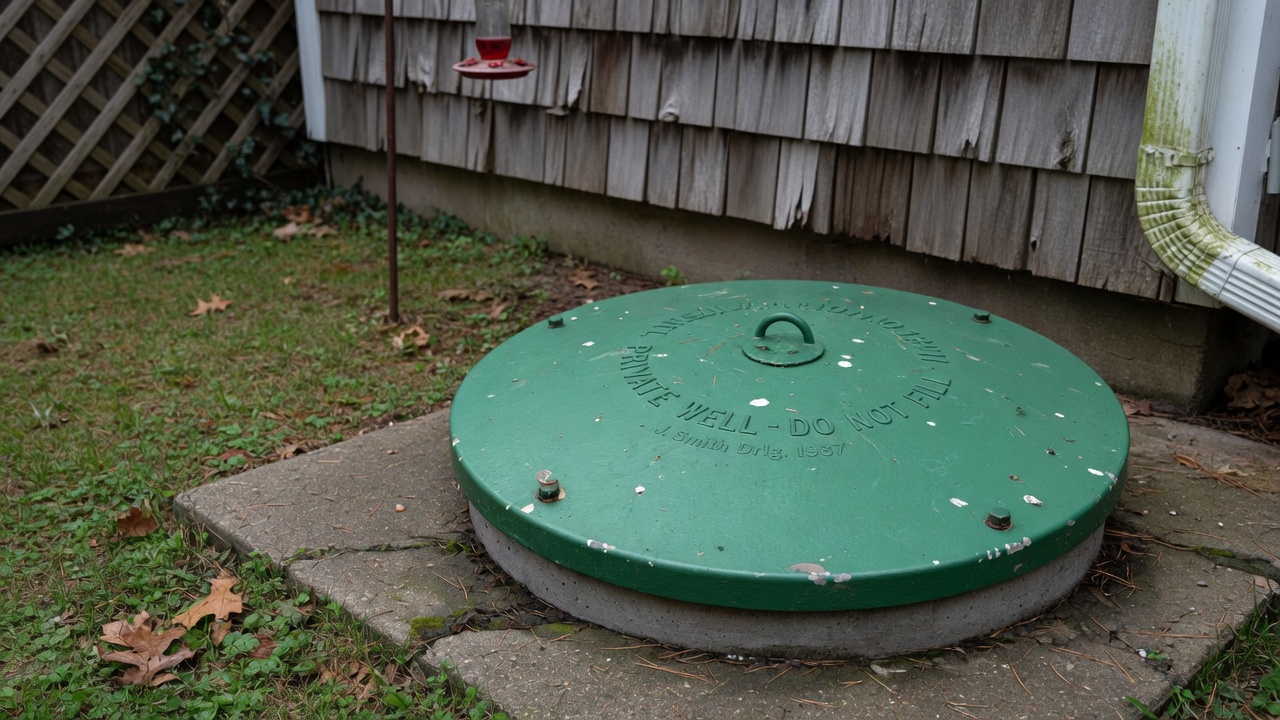
Start outside. Look for a round well cap in the lawn, often close to the house, sometimes in a patch the mower skips. Then look in a basement, a crawl, or a small well house for a pump and a pressure tank. Then look at the bills. A regular Suffolk County Water Authority bill usually means this kitchen is on public water. No water-district bill, plus a pump, usually means a well. Do not guess from the next driveway. Do not guess from a Mattituck headline. Do not guess from a Greenport village block.
If you just got the keys, ask for the last water bill and walk the grass that week. Closing papers can name a well and still skip the two chemicals this kit is for. If you rent, ask who pays the water and whether there is a cap. Silence is still a well until a lab. If you only open the house from Friday to Sunday, the dark weekday does not put a plant on the pipe. A North Fork weekend kitchen is still a kitchen if anyone drinks. Coffee on a Saturday still counts. A month after Labor Day still counts.
Some lots keep a well for irrigation after the kitchen connects. If people still drink, cook, and make coffee from that well, this kit is the job. If the well only waters vines or a lawn, and the kettle is already on a district, skip the kit. Kids' glasses from the same tap are the reason to fill bottles, not the sprinkler. If the kitchen already sits on a treated district line, use the PFAS and 1,4-dioxane tap guides. The county-wide well guide lives on the Suffolk wells page. This page is the Cutchogue fork: already on the main, or still a well.
Bottle-fill steps, the $12 hardware strip, and Suffolk's $100 county panel live on the Suffolk wells guide, not here. Order the kit from the button on this page if this Cutchogue kitchen still drinks a well, then follow that guide for the sample.
Fill this Cutchogue tap, then shop the report
A Cutchogue house that sits dark on weekdays is still drawing the same sand. Fill bottles at the cold kitchen tap you drink, on a day you are there — not a dock hose, a garden hose, or an outdoor shower. Do not leave a full bottle on a hot porch. Bottled water on the counter does not name the kettle. If the pasta pot, the ice, or the kids' glasses still come from the well, you are still drinking the well.
Read the report at the kitchen table. Match the chemical to the tool. Do not buy a mystery pitcher because a neighboring hamlet was in a headline. If PFAS comes back high, shop a unit tested for those compounds — NSF 53 or P473 on the box, or reverse osmosis under the sink. A fridge pitcher that only says it filters water is usually chlorine and taste. If 1,4-dioxane is high, skip the jug. Reverse osmosis is the class. A pitcher is a refund for that chemical. Test first if you drink a well. Buying the box first is how a pitcher ends up in the fridge and the well stays the well.
Cartridges are a yearly cost after you install something that actually matches the report. That later bill lives on the replacements page, not here. Do not hang a well kit on a district tap. Do not hang a Superfund headline on either job. Do not hang Mattituck's 20 of 38 on this kettle. Measure this tap.
If you buy through a link on this page, we may earn a commission. How that works
Common questions
Is Cutchogue covered by Mattituck's 20 of 38 well sample?
No. Twenty of 38 is a Mattituck hamlet sample. Cutchogue is the next hamlet east. That fraction does not name this tap. Fill bottles here.
Does every Cutchogue house drink a private well?
No. Some lots never joined a main. Some later streets pay a water-district bill. The bill and a cap in the grass settle this lot, not the hamlet name.
Do I still order a well kit if I already pay a Cutchogue water bill?
No. Skip the kit on a district kitchen. Match a PFAS filter or reverse osmosis to the tap you drink. If a well still feeds coffee, test the well.
Is this the Greenport or Southold Town page?
No. Greenport is the village farther east. Southold is the town. Cutchogue is the hamlet between Mattituck and Greenport. Measure this kitchen.
Does Suffolk's $100 well test look for PFAS on a Cutchogue well?
No. That cheaper county panel is a different product. The sample card lives on the Suffolk wells page. A mail-in lab kit is the one that looks for PFAS and 1,4-dioxane. This site is not that office.
What if a Cutchogue well report comes back high?
Match the chemical to the tool. NSF 53 or P473, or reverse osmosis, for PFAS. Reverse osmosis for 1,4-dioxane. A fridge pitcher is not that filter. Test first, then buy.
Can I fill the bottles at an outdoor shower or a dock hose?
No. Use the cold kitchen tap you actually drink from. An outdoor shower, a dock hose, and a garden hose are the wrong sample. Do not run the hot side.
We only open a Cutchogue house on weekends. Do we still test the well?
If anyone drinks the well when the house is open, treat it as a drinking well. A dark weekday does not put a plant on the pipe. Fill bottles at the cold kitchen tap on a day you are there.
Suffolk County well-plan figure and 2016–2022 sampling; Mattituck 20-of-38 stays on /mattituck/; Nassau ~85% sewered / Suffolk ~26% sewered; Magothy nitrate 1987–2013; county well-test line 631-852-5810; New York drinking-water standards; 34 federal + 449 state listed sites.